
Growth Needs a Harness Built Around the Audience
What Ivy (iHarness) does for any brand that wants to own its audience on every surface, and why it gets better with every decision.
Every growth team I talk to has more AI than it did a year ago. Copy gets written faster. Audiences get built faster. Dashboards refresh themselves. Yet for most of these teams, the numbers that matter haven't moved much: revenue per dollar of spend, cost to acquire a customer, how many customers come back.
Most of the AI conversation in marketing is about content: faster briefs, more drafts, quicker approvals. Across the 500+ growth teams using iCustomer, content is rarely what's stuck. The hard questions are who to reach, where, when, and whether it worked. In most stacks, AI sits at the center. The audience should.
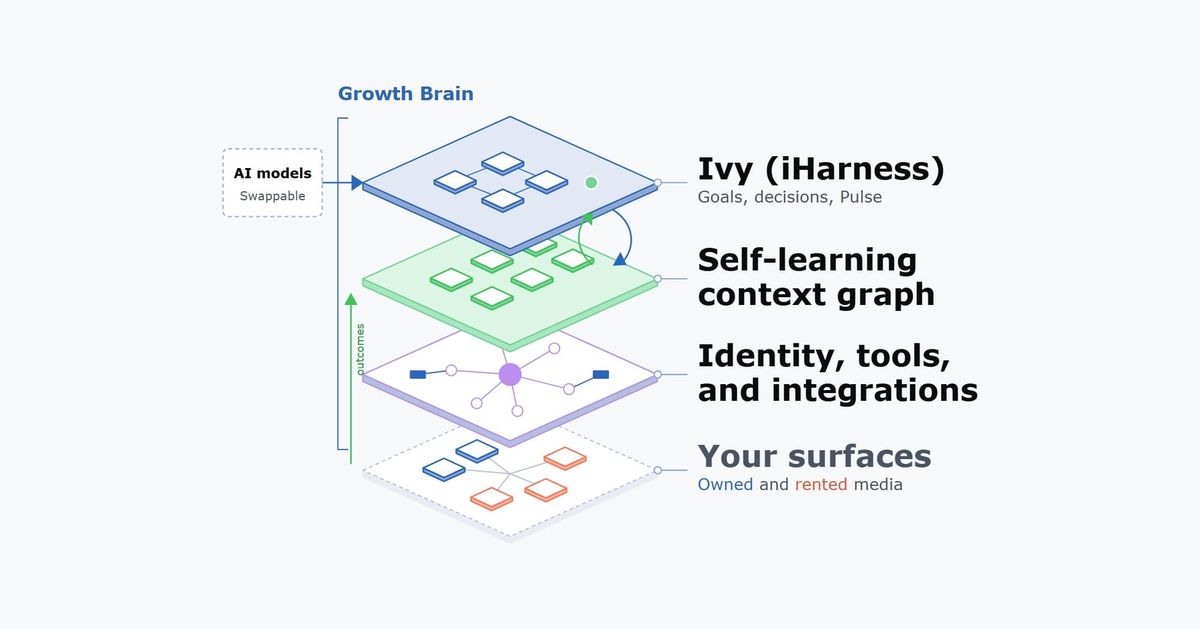
Answering those questions takes context, coordination, and rules, not more output. That's what a harness provides. It's the layer that holds context, coordinates the work, and enforces the rules, so AI acts on your business instead of guessing at it. Here's what a growth harness does when it's built around the audience, whether you sell sneakers or software. Ours is Ivy (iHarness), and it runs inside iCustomer Growth Brain.
It starts from a goal, not a task
Most AI tools wait for a prompt. Ivy waits for a goal.
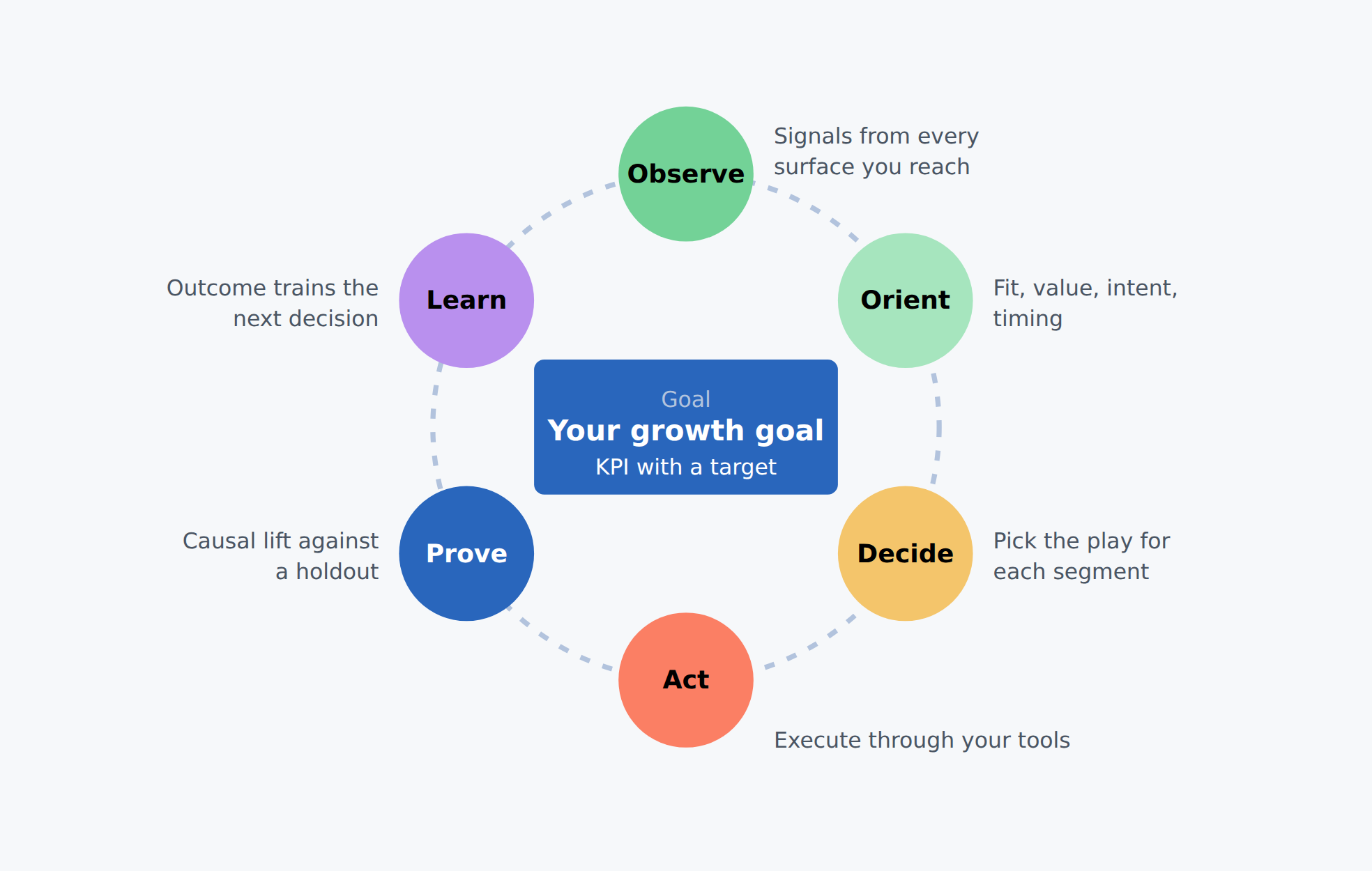
You pick one: new customer growth, retention, or pipeline. A goal holds KPIs, and each KPI holds a target. Ivy opens a decision loop for that goal and runs it continuously: observe, orient, decide, act, prove, learn. One loop per goal. Several can run at once, in the background, even when nobody is logged in.
Set a goal without a target and the loop stays in watch mode. It observes and proposes, but it won't act until you confirm a target. Agents with a goal and no finish line tend to wander.
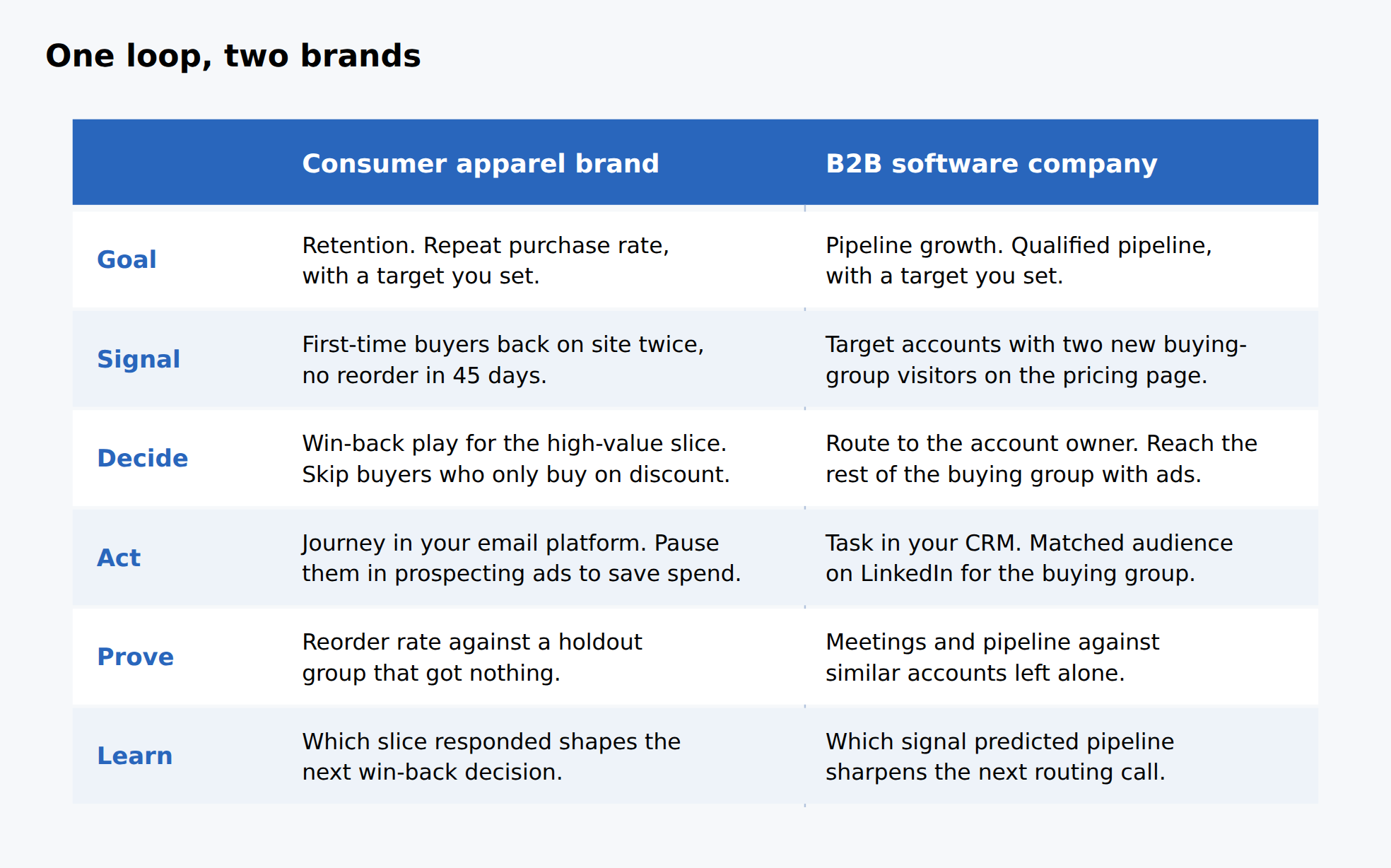
Here's what that looks like for two very different brands.
It knows your audience on every surface
A growth harness has to know the people. Which customers or accounts fit what you sell. Who is showing intent right now. Which of your best buyers is about to lapse. Which household or buying group went quiet after the last touch.
Your audience doesn't live in one place. People browse your site, open your app, buy in a store or on a marketplace, and scroll through feeds you rent. Each walled garden keeps its own picture of them. The brand is the only party that can see the whole person, and only if it owns that picture.
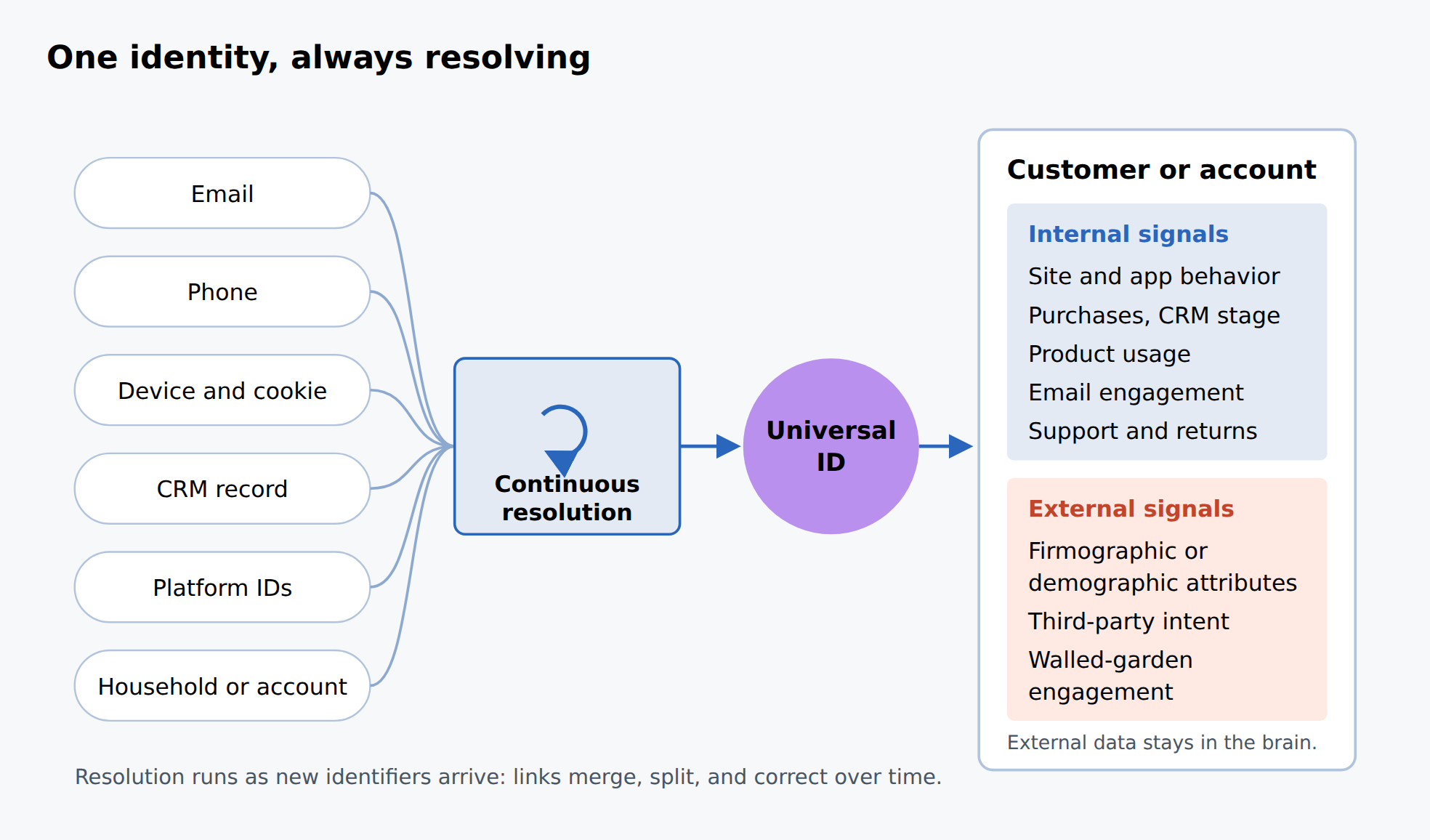
So every signal, decision, and outcome in Growth Brain hangs off one universal identity. A built-in identity graph keeps resolving it as people change emails, switch devices, show up as a new CRM record, or appear under a platform's own ID. New identifiers merge into the right profile, and stale links get corrected.
Each profile carries two kinds of signals. Internal ones come from you: site and app behavior, purchases, CRM stage, and product usage. External ones come from outside: firmographic and demographic attributes, third-party intent, and engagement inside the platforms you advertise on. External data is resolved to your IDs and never written raw into your systems.
Growth Brain keeps all of this in a self-learning context graph: your audience, your brand, and every decision made about them, connected. Creative stays with your team. Ivy's job is to tell them who, where, when, and why.
It decides with a reason
Knowing the audience is half the job. The other half is choosing what to do about it.
For each goal, Ivy ranks people and accounts by fit, value, and intent, then picks a play for each segment: who gets a win-back journey, who goes to sales, who joins a paid audience, and who gets left alone to save spend. Every decision comes with its reasoning: the signals it used, the play it chose, and the outcome it expects. That makes each one easy to approve, easy to challenge, and easy to audit later.
It acts through your tools
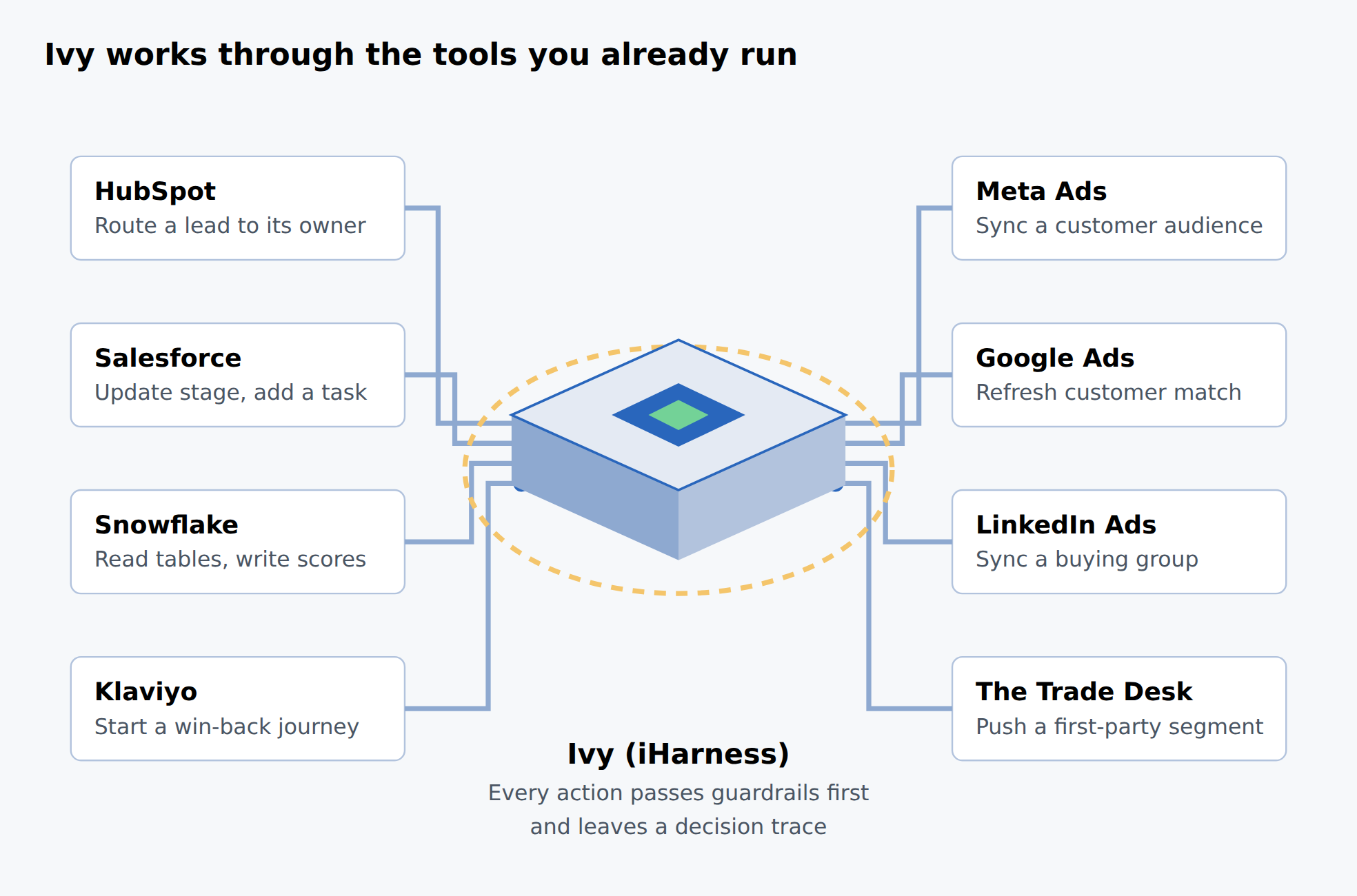
Ivy doesn't replace your CRM, commerce platform, email tool, ad accounts, or data cloud. It works through them, across 200+ connections: syncing audiences to ad platforms, starting lifecycle journeys, routing leads, writing scores back to your warehouse.
For enterprise teams, the whole system runs inside your own cloud, and nothing leaves except the activations you approve.
It proves what worked
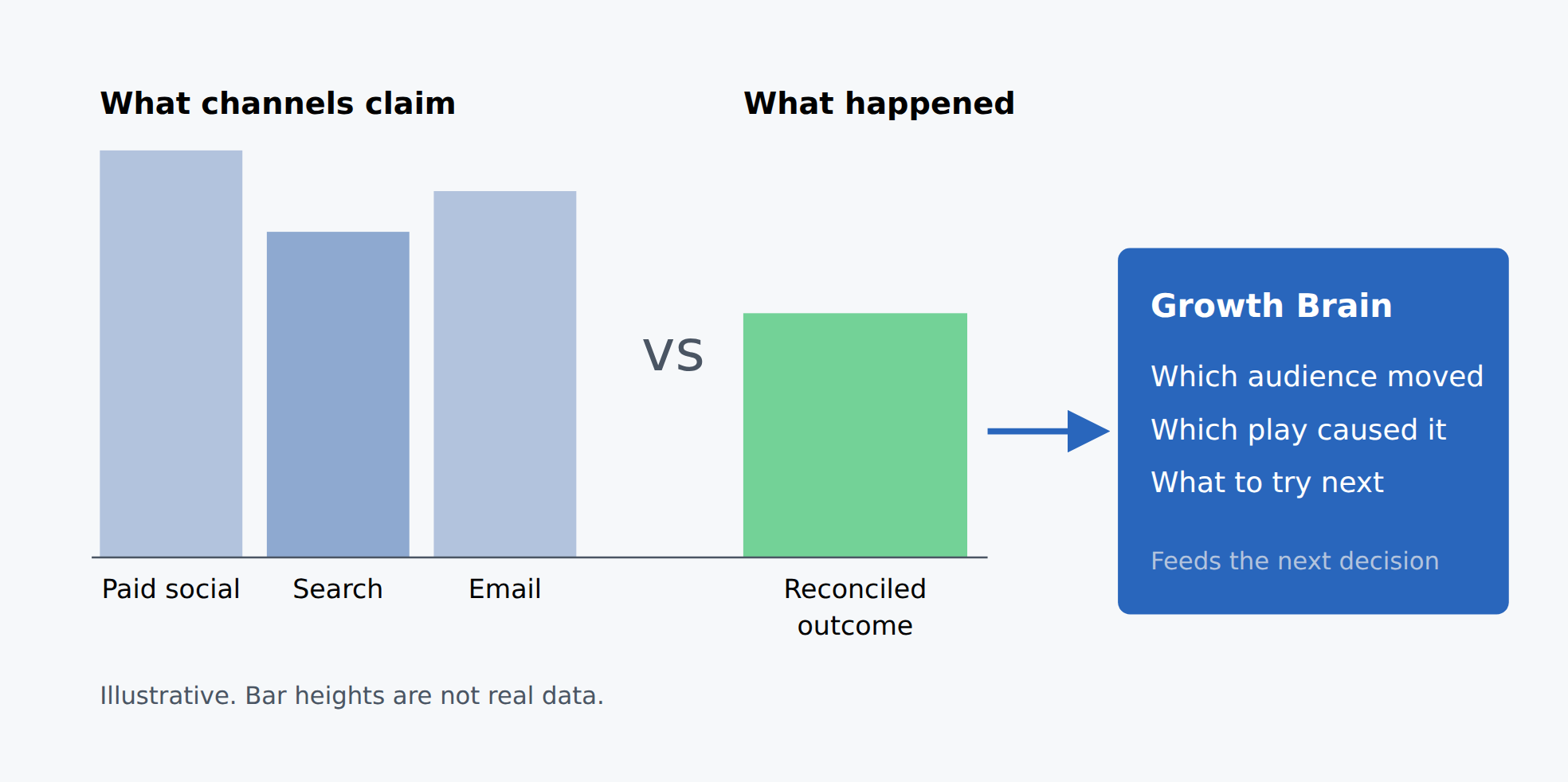
This is the part most AI marketing skips. Channels report on themselves. Every walled garden grades its own homework, and every one of them gives itself an A.
Ivy reconciles channel numbers against what happened to your audience: who was reached, who engaged, who bought, renewed, or moved into pipeline. It uses holdouts (groups you deliberately don't reach) and causal measurement, not last-click credit. You get a number you can take to your CFO, and the brain gets a result it can trust enough to learn from.
It compounds for you, not the platform
Every dollar you spend on paid media trains a brain. Today, it's mostly the platform's.
Meta and Google learn from every advertiser's results at once. Your best customers teach the platform who converts, and competitors can reach those same people in the same auction. Every brand rents the same optimization models, and the learning stays behind the wall: you get reports, the platform keeps the model. Suite vendors like Salesforce are building AI into their products too, and what it learns lives in their stack, not in an asset you own.
Meanwhile, the brand's own learning resets. A campaign ends, the team moves on or the agency changes, and the next campaign starts close to zero.
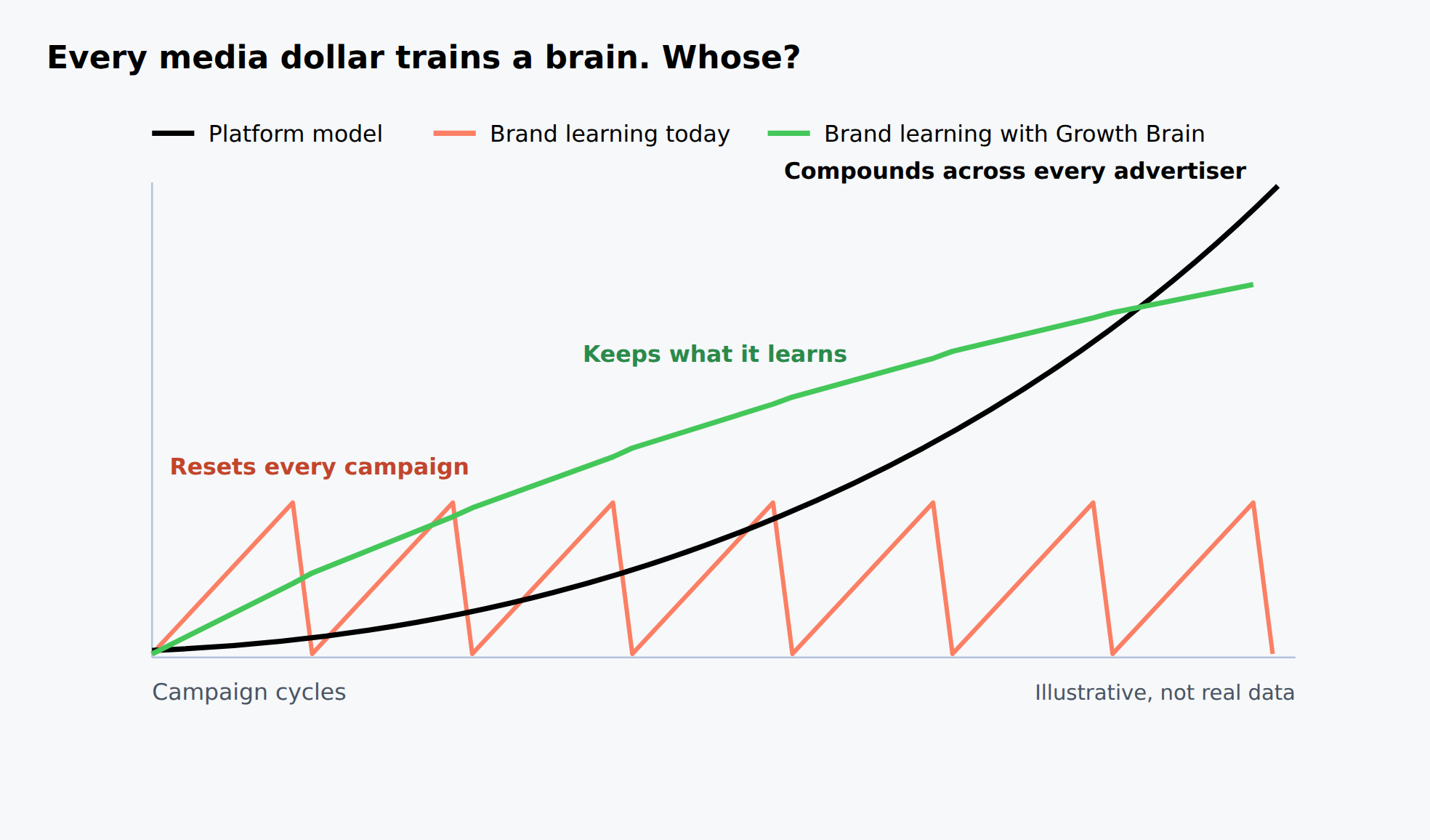
Growth Brain changes who keeps the learning. Every decision, holdout, and outcome is written into a context graph the brand owns. The platforms still optimize delivery. Your brain decides what to do with your audience, and it keeps what each campaign teaches.
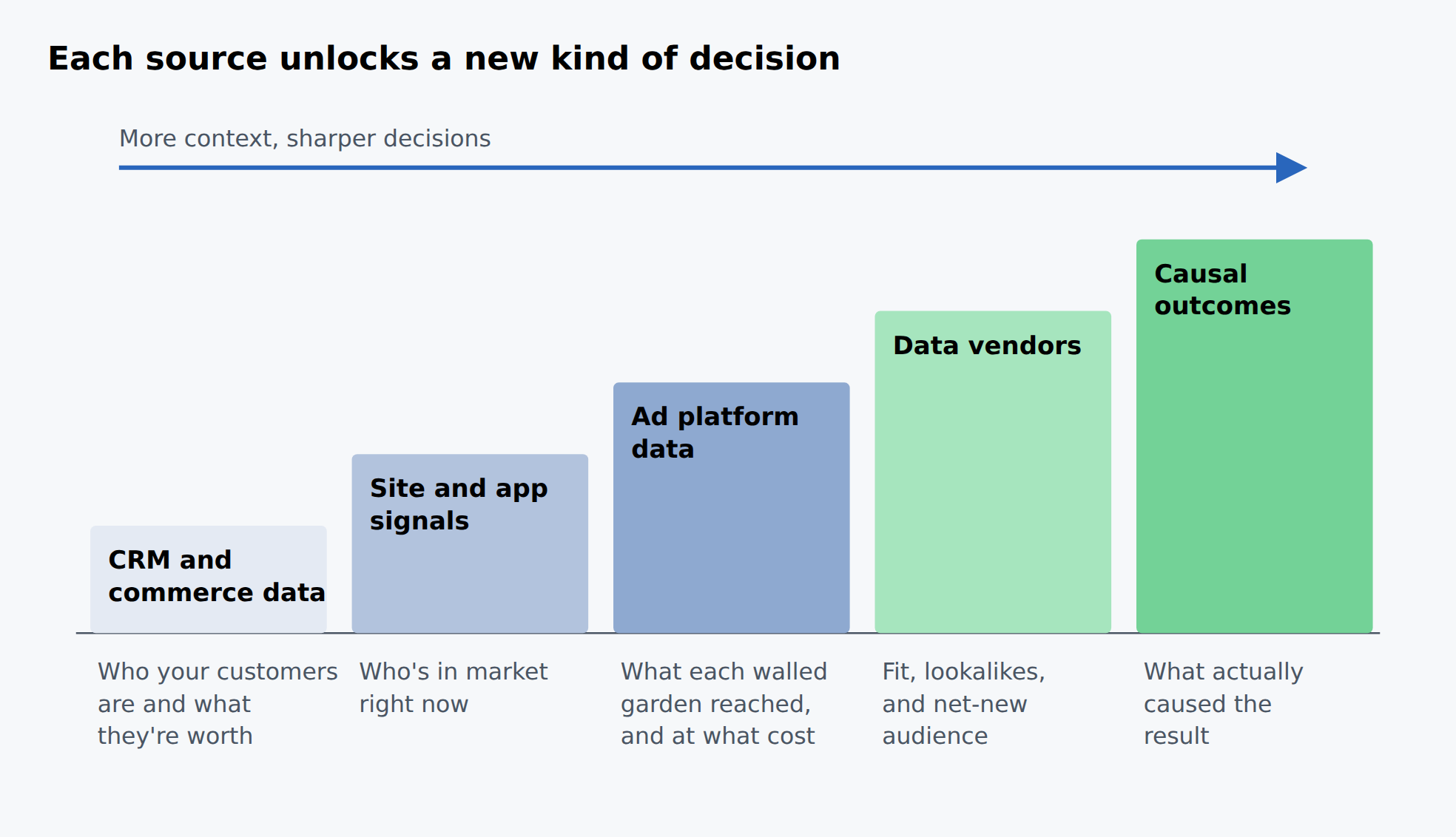
It improves in two ways: you give it more to read, and it learns from more outcomes.
Each source you connect unlocks a new kind of decision, from what a customer is worth to what actually caused a result. And because every channel feeds one brain, lessons travel. Search intent can shape who you target in paid social. A segment that renews well can define your next prospecting audience.
It keeps your team in control
Growth is a team sport. The analyst, the lifecycle lead, whoever owns paid, the CRM or RevOps owner, and sales where there is one. Ivy is built for that whole team.
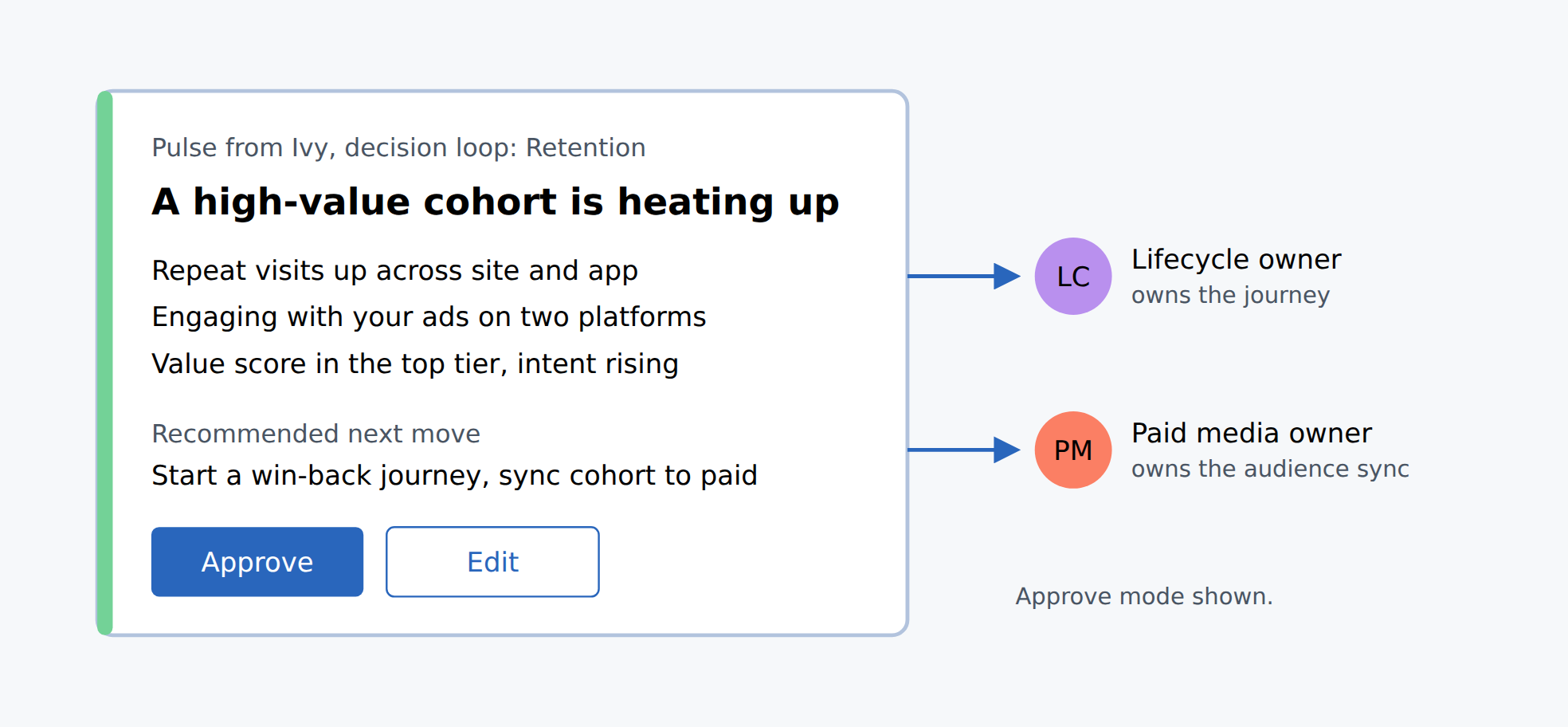
Anyone on the team can talk to Ivy, in the app or in Slack. When something needs attention, it sends a Pulse: an audience heating up, a campaign drifting off target, a high-value cohort about to lapse. Each Pulse carries the evidence and a recommended next move, and goes to whoever owns that decision.
You set how much Ivy does on its own. In approve mode it proposes and waits. In auto mode it acts inside limits you set. Guardrails define what agents can touch, what needs a human, and what's blocked outright, and every decision leaves a trace of what Ivy saw, what it chose, and why. Most teams start in approve mode and loosen it one play at a time.
A shared brain also fixes the handoffs. Marketing stops forgetting everything after the click or the lead, and the CRM finally sees the effort that produced the sale.
Putting it together
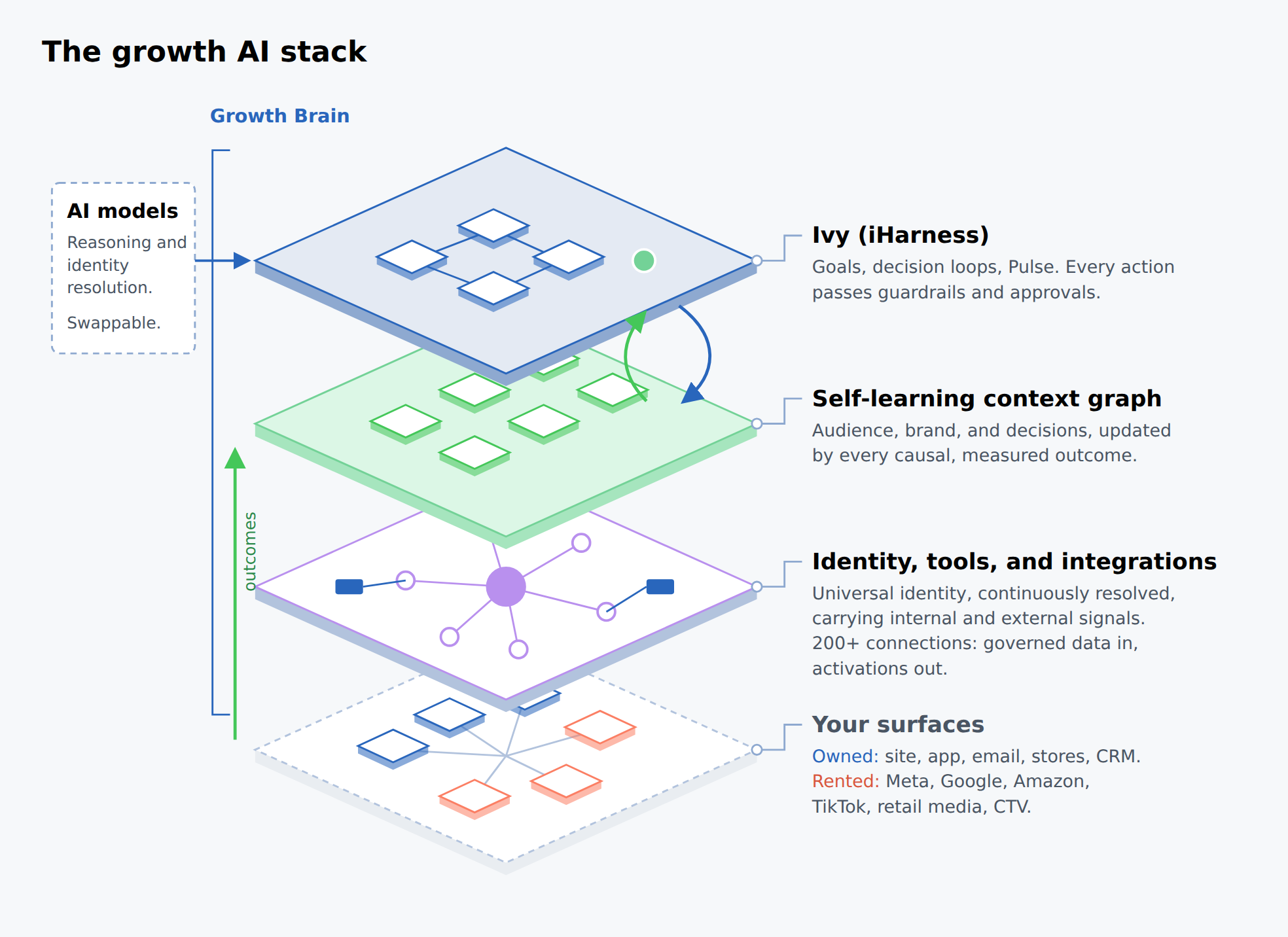
Here's the whole system in one picture. Growth Brain is three layers: Ivy on top, the self-learning context graph in the middle, and universal identity with your integrations underneath. Your surfaces stay yours. Models stay swappable.
What changes for you
- Spend goes to people who are in market, and stops on people who already bought or are unlikely to.
- Every decision has a reason and a trace you can show your CFO.
- Your team spends less time pulling lists and reconciling dashboards, and more on judgment and creative.
- What you learn about your audience stays with you, across channels, agencies, and quarters.
Your first week
You don't need to connect everything on day one.
- Connect your CRM or commerce data, and your site pixel if you have one.
- Pick one goal and set a target, or leave it in watch mode.
- Let Ivy watch for a few days and read its first Pulses.
- Approve a play or two. Add sources and goals as trust builds.
Enterprise teams get a forward-deployed engineer alongside them for setup.
Your competitors can rent the same AI. They can't rent what you've learned about your audience.
Enterprise deployments run inside Snowflake, Databricks, or GCP.
FAQ
What is a growth harness? A growth harness is the layer that holds context, coordinates the work, and enforces the rules, so AI acts on your business instead of guessing at it. iCustomer's is Ivy (iHarness), which runs inside Growth Brain and starts from a goal rather than a task.
How does Ivy prove what worked? Ivy reconciles channel numbers against what happened to your audience: who was reached, who engaged, and who bought, renewed, or moved into pipeline. It uses holdouts and causal measurement instead of last-click credit, so the result is one you can show your CFO.
Does Ivy replace my CRM or ad platforms? No. Ivy works through your existing CRM, commerce platform, email tool, ad accounts, and data cloud across 200+ connections. For enterprise teams the whole system runs inside your own cloud, and nothing leaves except the activations you approve.
Who keeps what the brain learns? The brand does. Every decision, holdout, and outcome is written into a context graph the brand owns, so what you learn about your audience carries across channels, agencies, and quarters instead of resetting with each campaign.
Decisions that compound, in your inbox the first Friday of every month.
No spam. Unsubscribe anytime.
Get the next issue
Decision intelligence for marketers. One issue, the first Friday of every month.