
Semantic Layer, Ontology, Context Layer: Why You Need All Three Before Agents Touch Your CDP or Data Cloud
Semantic layer, ontology, and context layer are not the same thing. They solve meaning, agreement, and memory, and the decisioning loop only closes when your stack has all three before agents act on your data.

In short: Semantic layer, ontology, and context layer are not the same thing. They solve three different problems: meaning, agreement, and memory. Most stacks have one and label it all three, which is exactly why agents give confidently wrong answers on top of otherwise good data.
Last month, somewhere, a shopping agent quoted a brand's spring promo price, the one that expired in April, inside an AI answer engine. The team found out from a customer's screenshot. Nobody could say which system the price came from, which definition of "active promotion" the agent used, or why it answered at all.
That is not an AI problem. That is a missing-layer problem.
Most enterprises use "semantic layer," "ontology," and "context layer" as if they were the same word. They are not. And conflating them is exactly why agents give confidently wrong answers on top of otherwise good data.
Here is the uncomfortable part: your CDP and your warehouse solved storage and identity within their own walls. They did not solve meaning, agreement, or memory across your stack. Those are three different problems, solved by three different layers, and the decisioning loop only closes when all three sit on top of your data layer.
The three layers, precisely
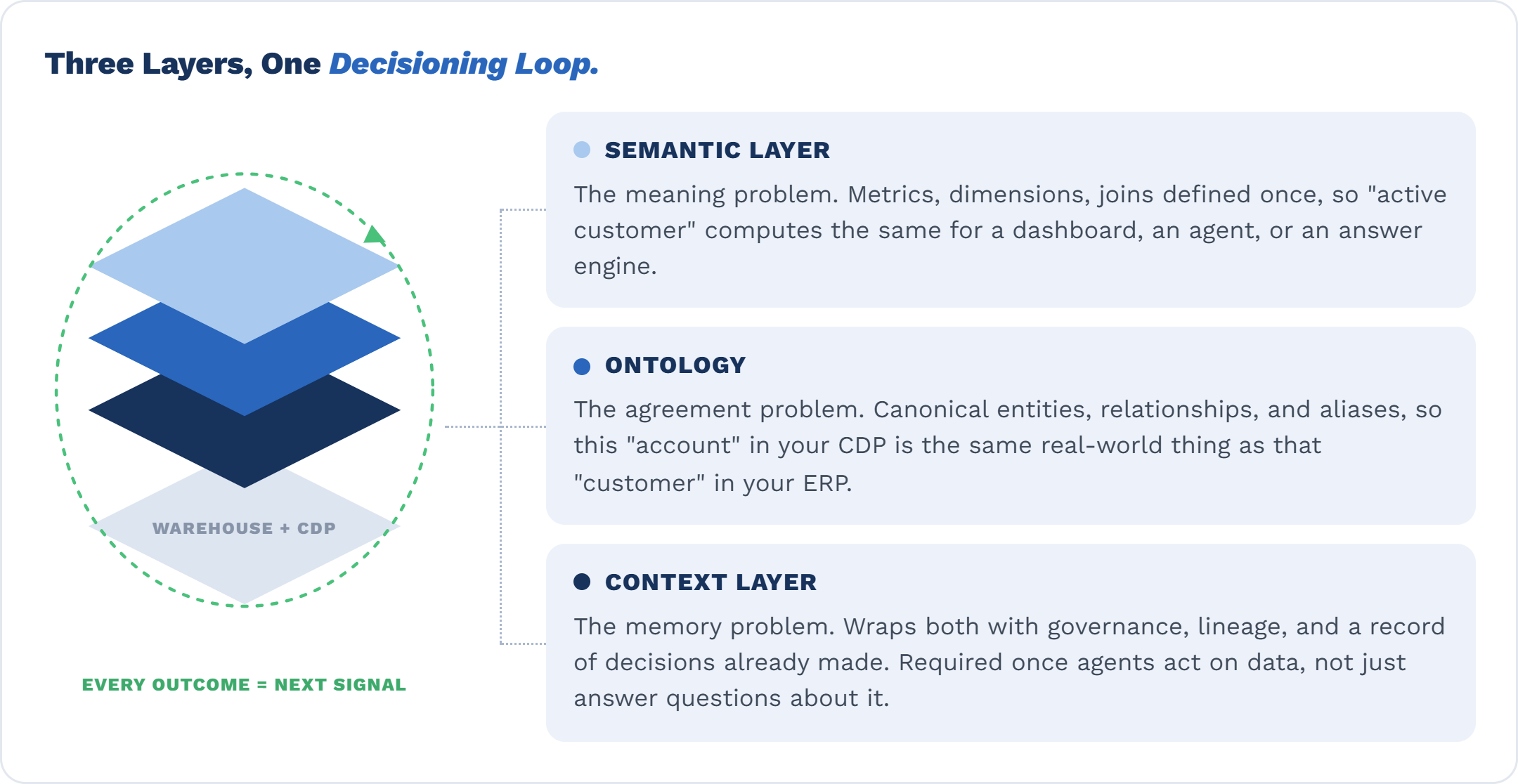
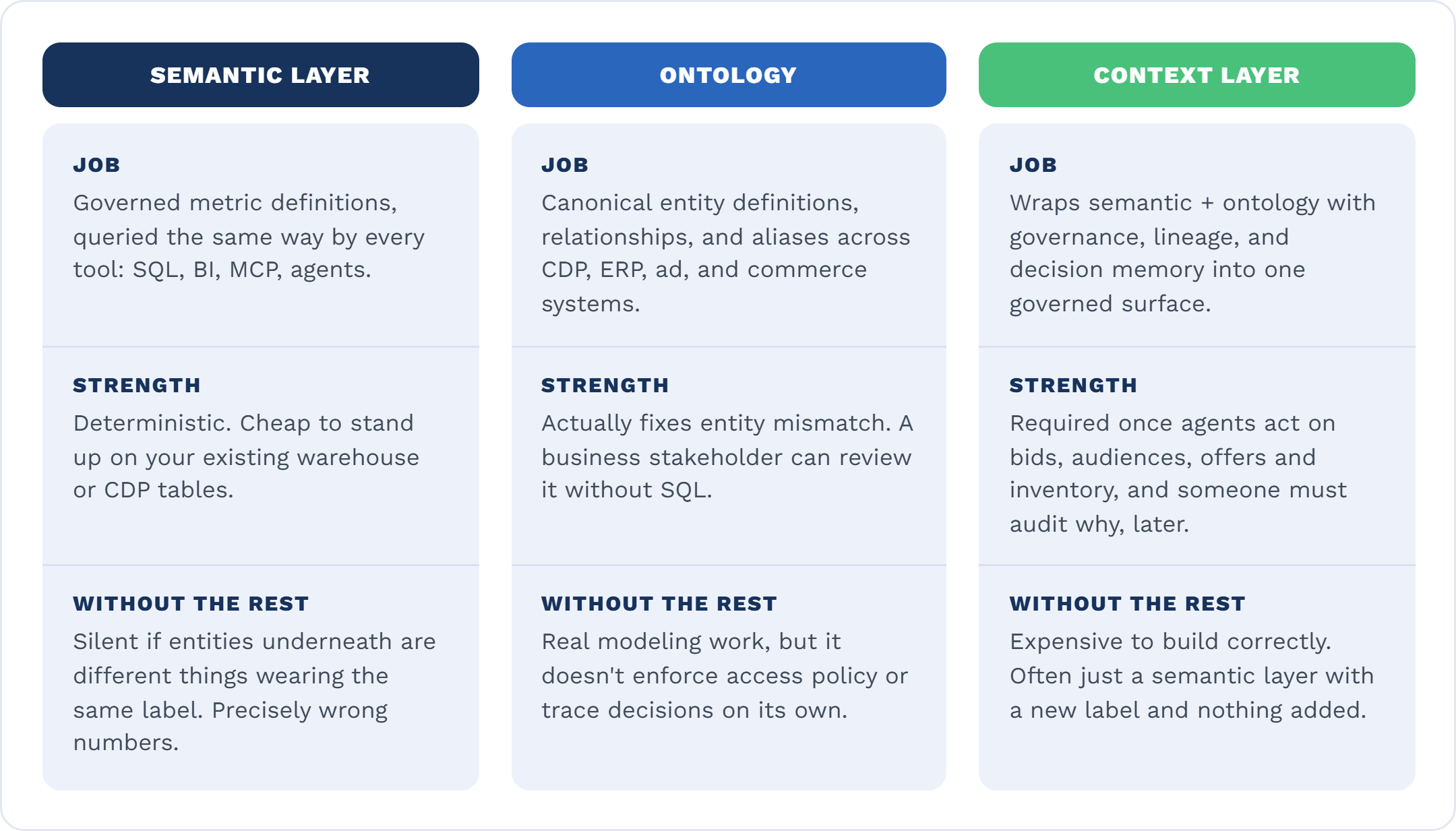
Semantic layer, the meaning problem. Governed metric definitions, dimensions, and joins, defined once and queried the same way by every tool (SQL, BI, MCP). "Active customer," "contribution margin," and "repeat rate" compute to the same number whether a dashboard asks or an agent does. It is deterministic and cheap to stand up on an existing warehouse. Its weakness: it is silent if the entities underneath are actually different things wearing the same label.
Ontology, the agreement problem. The entity and relationship model: canonical definitions, relationships, and aliases across systems. It says that this "account" in your CDP is the same real-world company as that "customer" in your ERP and that "advertiser" in your retail media platform. This is what actually fixes entity mismatch, and a non-technical stakeholder can review it without SQL. Its weakness: it is real domain modeling work, and it does not enforce access policy or trace decisions on its own.
Context layer, the memory problem. The operational wrapper around both: semantic definitions plus ontology, plus governance, lineage, and a record of decisions already made. It becomes mandatory the moment agents act on data rather than just answer questions about it. Its weakness: it is expensive to build correctly, which is why most "context layers" in the market are just a semantic layer with a new label.
Why this matters now, AEO and ecommerce specifically
Two forces changed the stakes in the last eighteen months.
- Answer engines are querying your brand. In an AEO world, LLMs and shopping agents synthesize answers about your products, pricing, availability, and policies. If your own systems cannot agree on what a "product," "bundle," or "in-stock SKU" is, the answer engine will not either. It will just be confidently wrong at scale, in someone else's interface, with no feedback loop back to you.
- Agents do not just read anymore; they act. Ecommerce agents adjust bids, suppress audiences, trigger offers, and reorder inventory. A wrong answer used to cost a bad dashboard. A wrong action costs margin, and it repeats itself every hour until someone notices.
The tolerance for ambiguity collapses when the consumer of your data is a machine acting at machine speed.
The failure mode nobody names
We see two versions of the same failure in almost every enterprise.
- Semantic layer without ontology. The team defines metrics beautifully, skips entity resolution, and the agent computes a precise number for entities that do not actually match across systems. Precisely wrong.
- Ontology relabeled as "context layer." The team builds an entity model, renames it on the architecture diagram, and skips governance and lineage entirely. Vocabulary inflation, not a new layer. The first time an agent takes a bad action, nobody can answer why it decided that, because nothing recorded the decision.

When to use what
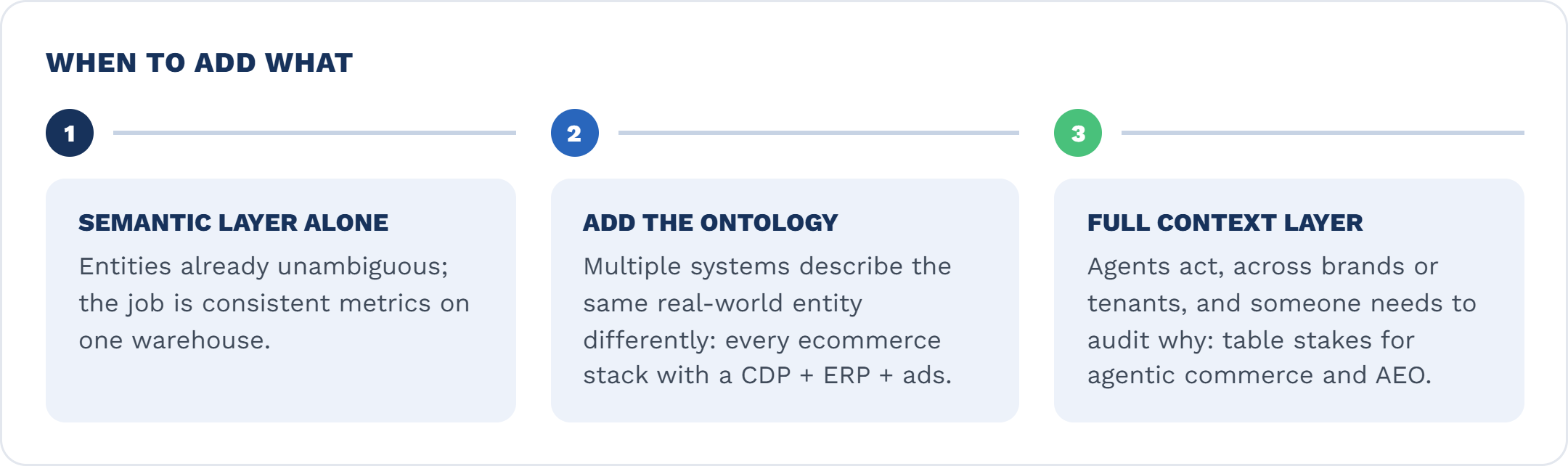
- Semantic layer alone, when entities are already unambiguous and the job is consistent metrics. Fine for a single-warehouse reporting stack.
- Add the ontology, when multiple systems describe the same real-world entity differently. This is every ecommerce stack with a CDP, an ERP, an ad platform, and a marketplace feed.
- Build the full context layer, when agents are allowed to act, across brands, regions, or business units, and someone needs to audit why months later. This is table stakes for agentic commerce and for any brand that wants answer engines to represent it accurately.
Inside the context layer: iCustomer Context Pillars
Master data management gave us the golden record, one trusted version of each customer. Agents need the equivalent one level up: golden context, one trusted, versioned set of context an agent is allowed to reason and act with.
iCustomer delivers this through our Context Pillars framework. The framework itself is open, so use it to audit any stack, ours or not. What the platform does is the enforcement: scoping, versioning, and tracing the pillars at runtime. Context is not one blob. It is four pillars, each with its own sources, owner, refresh cadence, and access policy.
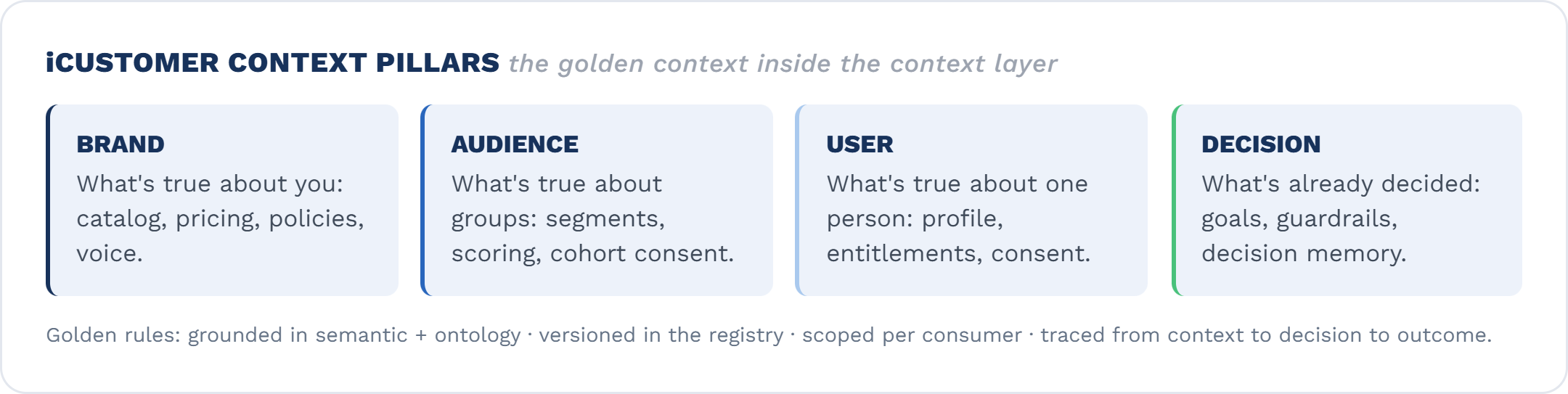
- Brand Context, what is true about you. Catalog, pricing, availability, promotions, policies (shipping, returns, warranty), brand voice, approved claims, compliance constraints. This is the kind answer engines consume. AEO is essentially publishing your Brand Context in machine-readable, governed form. Public by design, but only the approved version.
- Audience Context, what is true about groups. Segments and cohorts, ICP definitions, propensity and scoring models, suppression lists, cohort-level consent. Aggregate by design, with consent enforced as policy at query time, the working material of growth and ecommerce teams.
- User Context, what is true about one person or account. Identity-resolved profile, entitlements, order and interaction history, preferences, individual consent. Highest sensitivity, so it carries the strictest access policy and row and column governance.
- Decision Context, what you have already decided. Goals and guardrails, budgets, active experiments, and decision memory, prior decisions plus their outcomes. This is what stops an agent from re-litigating settled questions or repeating yesterday's mistake.
The pillars partition by subject: you, groups, individuals, and your own choices, which is what keeps them mutually exclusive. The framework is extensible; a Channel or Market pillar often comes next, but these four cover most enterprise agent surfaces.
Four rules make the pillars "golden."
- Grounded. Every context kind resolves through the same semantic layer and ontology, the same entities, the same metrics, no private vocabularies.
- Versioned. Context records live in the schema and ontology registry, so "which version did the agent use?" always has an answer.
- Scoped. Each consumer gets only its kinds: an answer engine gets Brand Context, never User Context; an activation agent gets Audience and Decision Context, and User Context only with consented entitlement.
- Traced. Every answer or action records the context kinds and versions it used, lineage from context to decision to outcome.
What goes wrong without the pillars: agents mix scopes, with user data leaking into a public answer, or they reason on stale context, last quarter's pricing in today's answer engine. The Context Pillars enforce the discipline of right pillar, right version, right consumer.
A context layer is curated, not installed
Every vendor now promises a context layer in the box. Be skeptical of any that ships without your people in the loop. The semantic definitions, the entity model, and the pillars above are not purely technical deliverables. They require human curation with domain expertise: which features and metrics actually matter, what "active," "churned," or "in-stock" means in your business, which claims are approved, which decisions are settled. Technical implementation resources alone produce a schema. Curation produces context. The working model is co-creation: your domain experts define and approve, and the platform versions and enforces.
And it does not require a new database. The context layer can materialize on your existing data layer, curated views and governed definitions on the warehouse and CDP tables you already run, not another copy of your data in another vendor's store.
How iCustomer closes the loop
This is where we sit: on top of your CDP and data layer, not replacing them. Your warehouse remains the system of record. And it is not rip-and-replace. If you have invested in a dbt or LookML semantic layer, a catalog like Collibra or Alation, or MDM golden records, those become inputs. We federate metric definitions, reference the catalog's lineage, and extend the golden record into golden context. The gap we fill is what none of those tools do: entity agreement across GTM systems, runtime scoping of context per agent, and decision memory.
The sequencing matters too. A semantic layer stands up on your existing warehouse in weeks, the ontology builds out one domain at a time, and the context layer starts scoped to your first agent use case. You do not build all three before the first loop runs, and this scoping is exactly how you contain the context layer's "expensive to build correctly" problem: one use case at a time, not the whole enterprise on day one.
We add the layers that turn stored data into governed decisions.
- Semantic and ontology as one governed surface. GTM entity types, relationships, aliases, and metric definitions, versioned in a schema and ontology registry, reviewable by business stakeholders, queryable by every tool and agent the same way.
- The context layer as an operating layer. The four Context Pillars, Brand, Audience, User, and Decision, plus governance and access policy, source-to-answer lineage, and decision memory, a durable record of assumptions, definitions, and decisions over time.
- A trace spine that makes decisions auditable and improvable. Events, identity, signals, decisions, outcomes. Every decision an agent makes is traceable back to the signal that triggered it and forward to the outcome it produced.
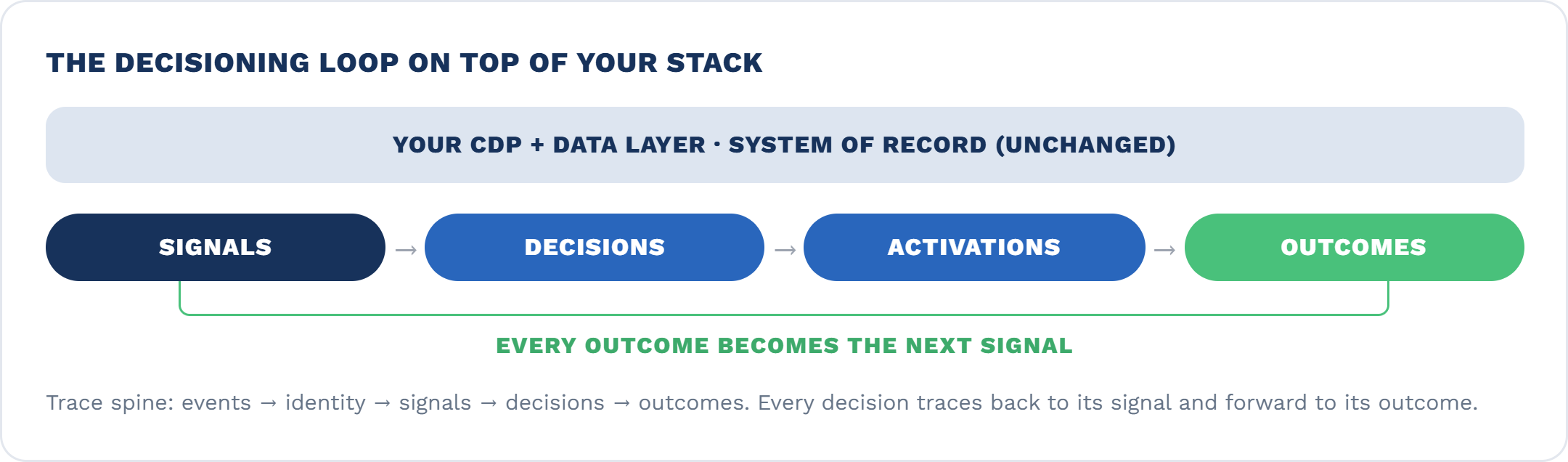
That last stream is the point. When outcomes flow back in as signals, you do not just have a stack that answers questions. You have a decisioning loop: capture signals, decide with governed context, activate across channels, measure outcomes, and let every result become the next signal. The loop compounds. A pile of layers does not.
Six questions to ask your team Monday
- Does "active customer" compute to the same number in the BI tool, the CDP, and whatever an agent queries? (semantic layer)
- Can anyone show that this "account," that "customer," and that "advertiser" are the same company, without writing SQL? (ontology)
- If an answer engine misquotes our price or return policy today, how would we know, and what is the correction path? (Brand Context)
- When an agent suppresses an audience or changes a bid, can we trace which data, definitions, and prior decisions it used? (decision memory)
- Which context can each agent see, and who approved that scope? (governance)
- Who on the business side owns and approves the definitions agents use, or is it purely an engineering deliverable? (curation)
If two or more answers are "we are not sure," you have a layer problem, not an AI problem.
The takeaway
- One layer gives you consistent numbers.
- Two layers give you consistent entities.
- Three layers give you decisions you can trust, trace, and improve.
Your CDP stores the data. Your martech builds the campaigns. Your adtech runs the media. The three layers above them decide what to do with all of it, and prove why.
Activate decision loops, not data.
Forward this to the one person in your organization who owns the architecture diagram, and ask them which of the three layers is actually running in production.
Decisions that compound, in your inbox the first Friday of every month.
No spam. Unsubscribe anytime.
Get the next issue
Decision intelligence for marketers. One issue, the first Friday of every month.