
Your ICP Is Not a Strategy. It's a Starting Line.
Account prioritization, not identification, is the real bottleneck in B2B growth. How the always-on FIRE Score turns a static ICP into a living intelligence loop.
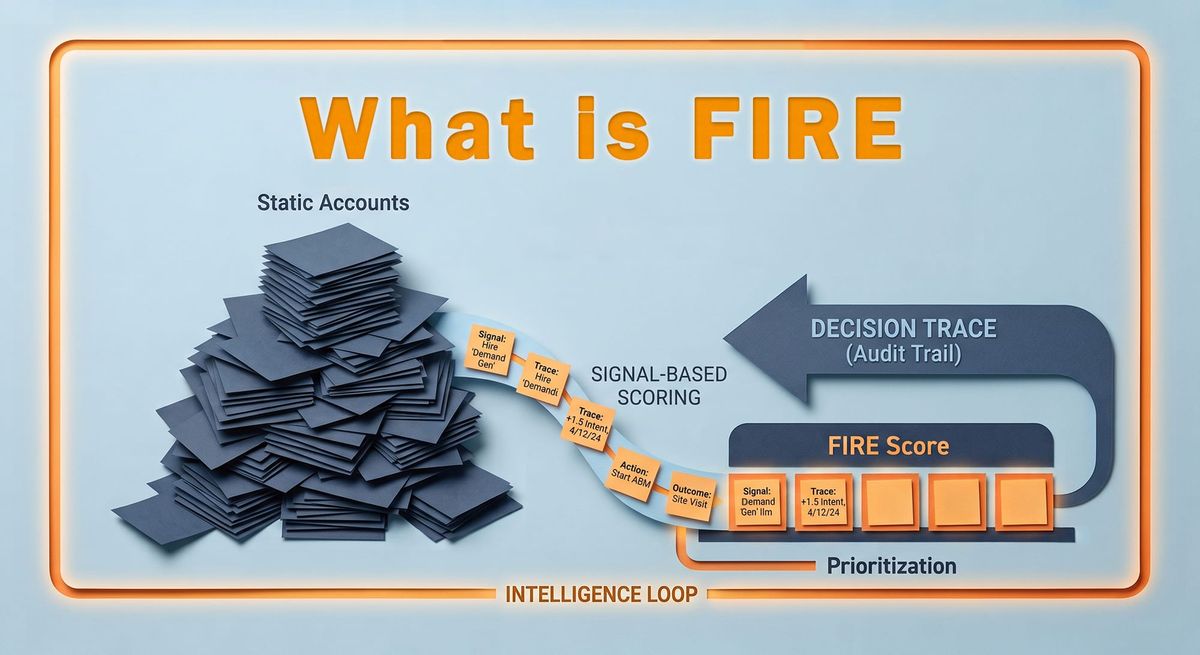
In short: Identification is solved; prioritization is not. A static ICP, a big list, and broad spend reset to zero every quarter. The FIRE Score (Fit, Intent, Recency, Engagement) is an always-on read at both the account and contact level that reprioritizes as signals move, records every decision as an auditable trace, and gives humans and agents one shared, warehouse-native substrate to act on.
Every growth team I meet has done the work. They've sized the TAM. They've written the ICP doc: firmographics, tech stack, funding stage, the whole matrix. It's in a slide, it's in the CRM, it's pinned in Slack.
And then Monday morning arrives, and the same question sits unanswered: out of the 4,000 accounts that fit, which 40 do we work this week? And inside those 40, which three people?
That's the gap almost nobody talks about. Identification is a solved problem. A decent data vendor and an afternoon gets you a list. Prioritization is the unsolved one, because a list tells you who could buy. It says nothing about who is ready, who is moving, or who is already looking at you.
So teams do what teams do under uncertainty: they spray. The whole list goes into LinkedIn ads. The whole list gets the sequence. Paid media budget gets spread across 4,000 accounts when maybe 200 are in motion. The cost isn't just wasted spend. It's that the 200 real opportunities get the same generic message as the 3,800 cold ones, and the signal that would have told you which was which never gets captured.
The problem with the scores you have
Most stacks already contain a "score." It's usually one of two kinds, and both fail the same way.
The first is the static fit score, built once, from firmographics, refreshed quarterly if ever. It tells you a company matches your ICP. It told you the same thing six months ago. It will tell you the same thing six months from now, whether that company just hired three demand gen leads or just went through layoffs. A score that doesn't move isn't intelligence; it's a filter with a number attached.
The second is the rented intent score: 6sense, Demandbase, Bombora and their kin telling you an account is "surging" on a topic. Genuinely useful as a signal source. But the model is a black box you can't see inside, you can't feed your own outcomes back into it, and it belongs to the vendor. When the contract ends, so does the intelligence. Your campaigns taught their model, and you paid for the privilege.
Both share a deeper flaw: they end at the account. Accounts don't open emails. Accounts don't click ads or visit pricing pages. People do. A prioritization system that stops at the account level hands your SDR, or your AI agent, a company name and a shrug.
FIRE: prioritization as a living system
This is why we built the FIRE Score the way we did: not as another static grade, but as an always-on read across four dimensions, computed at both the account and the contact level.
Fit is how well the company matches your ICP: industry, size, stack, data maturity. This is the slow-moving foundation. It's necessary and wildly insufficient on its own.
Intent is active signals of motion: hiring patterns, tech migrations, funding events, content consumption, competitive displacement signals. Fit says they could buy. Intent says something changed.
Recency is how fresh those signals are. A migration signal from last week and one from last year are not the same signal, but static systems treat them identically. Intelligence decays; the score should too.
Engagement asks whether they've touched you: visited the site, viewed the ad, opened the sequence, shown up in your community or content. Your MAP already tracks some of this, but in isolation, disconnected from fit and intent, and blind to the anonymous majority. This is where website and ad reveal matter: resolving anonymous engagement back to accounts and, where identity allows, to contacts, so the person quietly reading your pricing page twice this week stops being invisible. Two honest caveats, because ops people have been burned by reveal vendors. Resolution is probabilistic, so match confidence travels with the signal rather than being laundered into false certainty. And it runs consent-first: engagement you're entitled to see, not surveillance dressed up as data. (Regular readers will recognize the Consent Capital argument: engagement earned under consent is an asset precisely because it's defensible.)
Four dimensions, scored continuously, at two levels of resolution. The account-level FIRE Score answers which accounts this week. The contact-level score answers which humans inside them, because the VP who attended your webinar and the VP who has never heard of you should not receive the same message, the same channel, or the same spend.
"Isn't this just lead scoring with extra steps?"
Fair question, so let's take it head on. Yes, your MAP has scored engagement since 2010. Yes, serious intent vendors decay their signals. Every ingredient here exists somewhere in your stack already. What doesn't exist is the combination, and the combination is the point.
Three things your current stack doesn't do. First, it doesn't unify: fit lives in the CRM, intent lives in the vendor's platform, engagement lives in the MAP, and a human, usually an exhausted ops person, is the integration layer between them. Second, it doesn't learn from outcomes: no closed-lost deal has ever retrained a MAP score, and your intent vendor's model improves from your outcomes without ever giving that learning back. Third, and this is the architectural difference rather than a feature difference, it isn't yours. The FIRE Score runs warehouse-native: computed in your Snowflake or BigQuery, on your data, with every trace stored where you can query it. "You own the intelligence" isn't a marketing sentence; it's a deployment fact. When you can SELECT your own scoring history, ownership stops being a claim.
The loop is the product
Here's the part that separates a scoring feature from an intelligence system: what happens after the score triggers an action.
In most stacks, nothing. The campaign runs, results land in a dashboard, someone screenshots it for the Monday deck, and next quarter's targeting starts from roughly the same place. The learning dies at the point of reporting.
In a closed loop, every action generates evidence, and evidence retrains the score. Here's what that looks like in practice, over about two weeks.
An account sits at 5.2, good Fit, nothing moving. Then three demand gen hires post on their careers page, and Intent climbs. Four days later, an anonymous visitor from their IP block reads your pricing page twice; reveal resolves it to a director on the growth team, and Engagement moves with high match confidence. The composite crosses 8, and the account jumps the queue, not because someone remembered to check a dashboard, but because the system reprioritized overnight. The sequence that goes out isn't the generic one; it references the actual signals that raised the score. The director replies. That reply feeds Engagement again, the account holds its position, and spend that was spread across forty lookalike accounts concentrates on this one. Meanwhile, an account that went quiet for sixty days decays out of the top tier, and nobody wastes a Tuesday on it.
Segmentation stops being a quarterly workshop and becomes something the system redraws continuously.
And critically, every one of those decisions is recorded. We call these decision traces: a durable record of what the system decided, why, based on which signals, and what happened next. Decision traces are what make the loop auditable instead of magical. When your CFO asks why spend concentrated on 200 accounts instead of 4,000, the answer isn't "the AI said so." It's a trace you can open: these signals, this score, this action, this outcome. Institutional memory for every decision your growth engine makes.
That auditability isn't a compliance nicety. It's the trust layer that makes the next part possible.
Built for teams of humans and agents
Every growth org is quietly becoming a hybrid team. There's the ABM lead, the growth marketer, the RevOps analyst, and increasingly, alongside them, agents: researching accounts, drafting outreach, adjusting bids, triaging replies.
Agents change the economics of prioritization in a way that's easy to miss. A human SDR with a bad list wastes their own time. An agent with a bad list wastes it at machine speed: a thousand personalized-but-pointless emails before lunch. Agents don't fix a targeting problem; they amplify whatever targeting you have. Which means the scarce resource in an agentic growth team isn't execution capacity anymore. It's decision quality.
That's what a shared FIRE Score provides: a common prioritization substrate that humans and agents both read from and both write back to. The human sees a ranked queue with the reasons attached. The agent gets the same thing as structured input: machine-readable priorities with the evidence trail. When the agent acts, its outcomes flow back into the same loop, through the same decision traces, sharpening the same score the human sees the next morning. One nervous system, two kinds of hands.
Without that shared substrate, you get the failure mode already showing up in early agentic GTM teams: agents optimizing against stale lists, humans unable to explain what the agents did, and a stack that's faster but no smarter.
The compounding difference
Pull it together and the contrast is simple.
A static ICP plus a big list plus broad spend is a strategy that resets to zero every quarter. Nothing learned in Q3 makes Q4 targeting better, because the learning was never captured in a form the system could use.
An always-on FIRE loop compounds. Every ad view, every site visit, every reply, every closed-won and closed-lost feeds the score. The score reshapes the segments. The segments reshape the spend and the message. The outcomes feed the score again. Six months in, your prioritization engine knows things about your market that no vendor's model does, because it learned them from your outcomes, and you own every trace of how.
You already know your TAM. You already wrote your ICP. The question that decides your CAC, your pipeline quality, and increasingly your agents' usefulness is the one the ICP doc can't answer:
Right now, this week: who's actually in motion, and how do you know?
Audit your own stack
Whether or not you ever talk to us, run this test on what you have today. Five questions.
Does any score in your stack go down when an account goes quiet, or do scores only accumulate? Does a closed-lost deal change who you target next quarter, automatically, without an ops project? Can you combine fit, intent, and engagement into one ranked queue without a human stitching three exports together? If your CFO pointed at any account in your top tier and asked "why is this here?", could you show the evidence, or would the answer be "the model said so"? And if an agent started executing against your current lists tomorrow at machine speed, would you be comfortable with what it would do?
If you answered no to two or more, you don't have a prioritization system. You have a list with opinions. That's fixable, but not with a bigger list, and not with faster execution against the one you have.
A sharper question, answered continuously. That's what always-on intelligence means.
Next in the series: Part 2: How a FIRE Score Gets Made. How ICP scoring and signal-based prioritization produce the FIRE Score, how website and ad reveal feed Engagement, and how decision traces make the loop auditable end to end.
FAQ
What is the FIRE Score? FIRE stands for Fit, Intent, Recency, and Engagement. It is an always-on score, computed at both the account and contact level, that ranks who to work this week and moves as signals change, instead of staying frozen like a static fit score.
What is the difference between account identification and account prioritization? Identification tells you which companies match your ICP, which a data vendor can produce in an afternoon. Prioritization tells you which of those accounts are actually in motion right now and worth working this week. Identification is solved; prioritization is the unsolved bottleneck.
Why isn't a static fit score or a rented intent score enough? A static fit score never moves, so it cannot tell you what changed. A rented intent score is a black box you cannot feed your own outcomes into and do not own. Both also stop at the account level, and accounts do not open emails or visit pricing pages; people do.
Decisions that compound, in your inbox the first Friday of every month.
No spam. Unsubscribe anytime.
Get the next issue
Decision intelligence for marketers. One issue, the first Friday of every month.