
After the Score: Activation That Uses the Evidence
Most stacks build a good score, then activate it like it's 2015. How ABM plays, LinkedIn targeting, and outbound email get built from the score's own evidence.
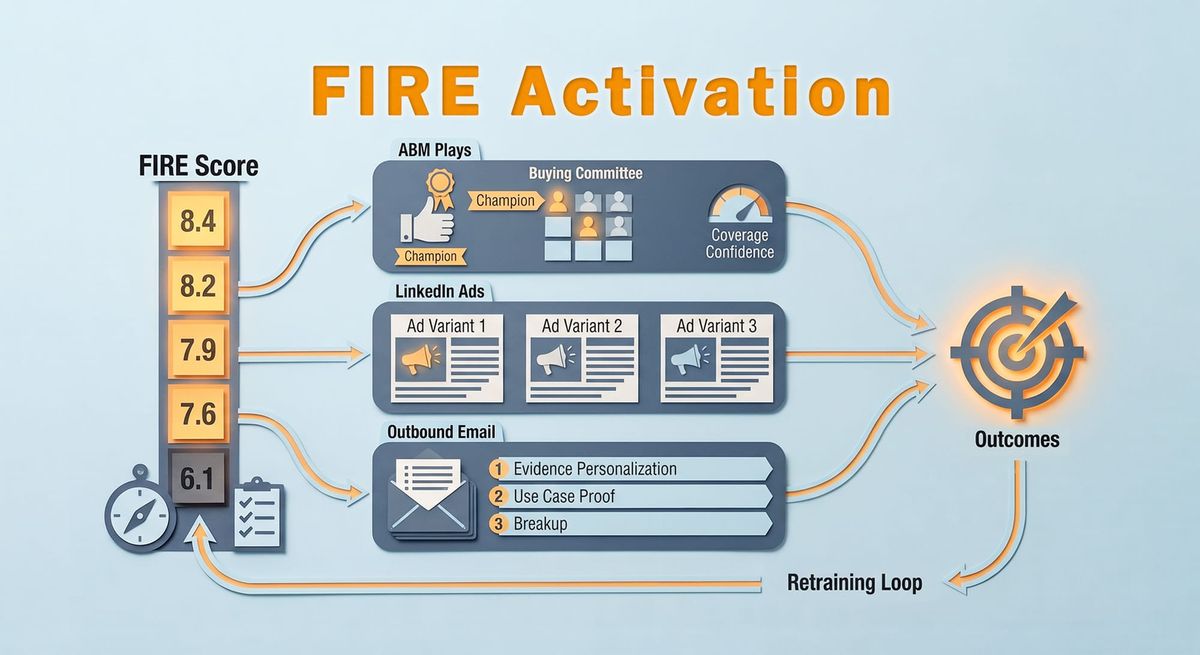
In short: A good score activated like it's 2015 wastes most of its value. In a loop, the signals behind the score choose the play: ABM plays triggered by signal composition rather than tier alone, LinkedIn budget concentrated on accounts in motion and suppressed elsewhere, and email built from the account's own evidence. Every touch feeds back, so the three channels share one memory and one auditable incrementality test.
Here's the quiet failure mode of every scoring project I've seen: the team builds a genuinely good score, ranks the market beautifully, and then activates it like it's 2015. The top tier gets dumped into the same LinkedIn campaign with the same three creatives. The same sequence goes to everyone above threshold. The score decided who; nothing downstream uses why.
That's leaving most of the value on the table. The evidence behind a score, the named, timestamped signals from Part 2, is exactly the raw material for what to say, where to say it, and how much to spend saying it. Activation is where the loop pays for itself, or doesn't. Let me make that concrete across the three channels where growth teams actually live.
ABM: plays triggered by signal composition, not tier alone
Traditional ABM tiering is static: Tier 1 gets the field event and the direct mail, Tier 2 gets the ads, Tier 3 gets the newsletter. Assigned quarterly, executed regardless of what any account is actually doing.
In a loop-driven model, the tier is live and the play is chosen by what's driving the score. Two accounts can both sit at 8.2 and deserve completely different treatment. Walk through one.
An account crosses 8 on the strength of three demand gen hires and a resolved pricing-page visit from a director of growth. The signal composition tells you the play: this is a building account, a new team, active evaluation, one engaged human. The right move is contact-level orchestration around that director (they're already leaning in) plus their likely boss (who'll sign), with messaging about standing up a motion, not switching one. Meanwhile a second account at the same score got there through competitive displacement signals: churning off an intent vendor, "too expensive" in a public forum. Same tier, opposite play: migration-framed messaging, a comparison asset, outreach to the ops lead who owns the contract.
The benefit for ABM teams is precision without headcount. The perennial ABM problem is that real one-to-one treatment doesn't scale past a few dozen accounts because a human has to read each one. When the signal composition selects the play, the reading is already done. Humans review and run the play instead of reconstructing the account story from six tabs. And because plays are trace-linked, the quarterly ABM review changes character: instead of arguing about whether Tier 1 was the right list, you can see which signal patterns actually converted and re-weight toward them.
Two things ABM teams will rightly demand of any system like this. First, the buying committee, because accounts don't buy, committees do. The contact-level view has to answer coverage questions, not just ranking questions: your champion is engaged, but no economic buyer has been touched; the ops lead who owns the incumbent contract has never seen your name. When committee gaps are visible in the same view as the score, "multithread this account" stops being a pipeline-review scolding and becomes a play the system suggests with the missing roles named.
Second, sales. A queue that reorders itself weekly is terrifying to an AE with a territory unless they can see why, so the queue has to surface where sales lives, in the CRM, with the trace evidence attached to the account record. When the AE opens the account that jumped twelve spots and sees "three demand gen hires July 2, resolved pricing visit July 9," the reordering reads as intelligence, not chaos. ABM programs don't die from bad tiering; they die from sales quietly ignoring the tiers. Evidence in the account view is what earns the trust that alignment meetings never quite do.
LinkedIn paid media: concentration instead of spray
LinkedIn is where undifferentiated activation gets expensive fastest. The default motion, sync the whole ICP list, run three creatives, let the algorithm figure it out, spreads budget across thousands of accounts when a few hundred are in motion. CPMs on B2B targeting are brutal; paying them to build "awareness" with accounts showing zero signals is the single largest quiet waste in most paid budgets.
Score-driven activation changes the mechanics in four ways.
First, audience tiers sync from the score, continuously, with an honest caveat for anyone who runs these campaigns: LinkedIn's matched audiences refresh on a lag and carry minimum sizes, so this is continuous directional pressure on targeting, not real-time bidding. The pressure still compounds; it just isn't instant. Accounts above threshold get the retargeting-intensity treatment; mid-tier gets lighter-touch awareness; below threshold gets suppressed entirely. Suppression is the underrated half: every account you stop showing ads to funds frequency against accounts that are actually moving.
Second, creative follows the signal, at the theme level, not one ad per account. A handful of variants mapped to signal patterns is operationally sane; per-account creative at B2B tier sizes isn't. The building account from the ABM example sees creative about standing up audience intelligence for a new team. The displacement account sees the migration message. Same product, same platform, but the ad rhymes with what's actually happening inside that company, which is the difference between "relevant" and "wallpaper."
Third, decay drives budget out, not just in. When an account goes quiet and its score drops, it exits the high-intensity audience automatically. No more quarterly list-hygiene project; no more spending March budget on January's interest.
Fourth, and this is where the loop closes, ad engagement flows back as signal. An ad view or click, resolved to the account (with match confidence attached, per Part 2), moves Engagement. Paid media stops being a parallel silo reporting its own vanity metrics and becomes a sensor: it doesn't just spend against the score, it feeds it. An account that starts engaging with ads climbs the queue for outbound and ABM, which is exactly the sequencing you want, because now the email lands on someone who's seen you twice this week.
Email: sequences built from the score's own evidence
Email is where signal-level activation is most visible, because email is where generic activation is most punishable, especially with a growth and ops audience that builds sequences for a living and deletes pattern-matched outreach on sight.
We've built our own outbound this way, on Instantly as the ESP, and the mechanics transfer to any sending tool. The audience syncs from the loop with the evidence attached: not just email and first name, but the account's FIRE score, its two strongest signals in plain English, and a persona-level pain line. The sequence then uses them. The first email can say, in effect: our system scored your company 8.4, driven by your three demand gen hires and your Snowflake expansion, and here's the loop that produced that score, want to see it? The scoring is the personalization. No competitor can credibly copy that email, because the email is evidence of the product working.
The operational mechanics matter as much as the copy. Contacts enter the sequence when the score crosses threshold, not when someone remembers to upload a CSV. Replies and clicks flow back as Engagement, feeding the same traces everything else feeds. Contacts whose scores decay exit the sequence instead of receiving break-up email number four into the void. And routing rules keep the score honest: any contact missing clean signal data gets a variant without the score line, because one garbled merge field in front of an ops buyer burns the whole premise.
The benefit shows up in the metrics email teams already watch: reply quality over reply volume. A sequence that references real, checkable facts about the recipient's company draws replies from people who recognized themselves in it, which is a meeting, rather than "unsubscribe" from people who recognized a template.
One queue, three expressions
Notice what's shared. ABM, LinkedIn, and email aren't three strategies with three lists. They're three expressions of one continuously ranked queue, each drawing on the same trace evidence, each writing its outcomes back into it. The account that engages with the LinkedIn ad climbs the queue for email; the email reply triggers the ABM play; the play's outcome retrains the weights that rank tomorrow's queue. And because every touch on every channel is traced, the incrementality test from Part 2 works across all of them at once: hold out accounts, compare pipeline, measure the lift rather than asserting it.
This isn't a whiteboard architecture. It's the loop running in production for teams like ReversingLabs, with visitor intelligence resolving into BigQuery, writing back to Salesforce, feeding the decisions their growth team acts on, and it's what 100+ companies run on Audience Loop today.
That shared substrate is also what makes the whole thing safe to hand to agents: an agent adjusting LinkedIn budget, an agent drafting sequences, and a human ABM lead running plays all read the same scores with the same evidence attached, and every action any of them takes is traced. Cross-channel coordination stops being a weekly sync meeting and becomes a property of the architecture.
And the compounding argument from Part 1 lands hardest here. A team that activates from static lists resets to zero every quarter on every channel independently. A team activating from a shared loop gets smarter on all three channels at once, because a lesson learned in paid media (this signal pattern doesn't convert) immediately sharpens email targeting and ABM tiering too. Three channels, one memory.
That's the series: prioritization is the bottleneck, the FIRE Score is the always-on answer, and activation is where the evidence earns its keep. If you want to pressure-test any of it against your own stack, the five audit questions from Part 1 are the fastest place to start.
And if you'd rather just see it than audit around it: Audience Loop starts free, and the first thing it shows you is your own market, FIRE-scored, the same view our outbound builds its emails from. The product demos itself the way this series described.
FAQ
How does signal-based scoring change ABM? The tier becomes live and the play is chosen by what is driving the score, not by a static quarterly assignment. Two accounts at the same score can get opposite plays, for example a building account with new demand gen hires versus a displacement account churning off a competitor, with the trace evidence attached in the CRM where sales works.
How does it change LinkedIn paid media? Audience tiers sync from the score continuously, so budget concentrates on accounts in motion and suppresses the rest. Creative follows the signal at the theme level, decayed accounts drop out of the audience automatically, and ad engagement flows back as a signal that feeds the score.
How does it change outbound email? The audience syncs with the evidence attached, so a sequence can reference the account's actual FIRE score and its strongest signals in plain English. Contacts enter when the score crosses threshold and exit when it decays, and replies feed back as engagement. The result is reply quality over reply volume.
Decisions that compound, in your inbox the first Friday of every month.
No spam. Unsubscribe anytime.
Get the next issue
Decision intelligence for marketers. One issue, the first Friday of every month.